The Death of the Hip-Hop Journalist (And the Rise of the Independent Voice)

Rob Markman stands outdoors on a city street. He looks directly at the camera wearing a black New York Yankees baseball cap, a grey thermal shirt, and a brown puffer vest with a white sherpa collar. The background shows blurred traffic and city lights
Part I: The Rob Markman Paradox (The Executive Disguised as an Ally)
To understand why traditional hip-hop journalism has decayed, one must dissect the career architecture of Rob Markman.
For years, Markman has presented himself as a seasoned elder statesman of hip-hop commentary—a champion of lyricism, a bridge between artists and audiences, and a benevolent veteran of the game. He does not present as a malicious figure; by all public accounts, he is cordial and well-intentioned. But good intentions do not negate structural compromise.
The tragedy of Markman’s modern positioning is not personal malice. It is the dangerous illusion he sells to independent creators:

The image is divided into four stages. Stage 1 shows a young artist looking up with admiration at a suited corporate gatekeeper. Stage 2 depicts the artist kneeling to kiss a diamond ring held by the gatekeeper. Stage 3 illustrates the trade-off, showing a gear and record representing leverage and independence being swapped for a corporate ID badge representing sanitized access. Stage 4 shows the artist looking defeated inside a cardboard box labeled SHELF, holding a phone with viral social media stats but sitting in a dark, empty space.
When a creator looks at Markman and assumes that appeasing him is the prerequisite to industry longevity, they are walking straight into a snare. Markman is not an objective journalist holding the culture's mirror. He is an executive navigating competing corporate obligations.
Consider the fundamental conflicts that gut his credibility as an independent voice:
The Corporate A&R Conflict: As the Vice President of Music and Content at Genius, Markman's explicit mandate includes brokering brand partnerships and securing artist distribution deals. How can an individual objectively dissect an artist’s exploitative contract or plummeting cultural value when that same individual’s corporate bonus depends on closing distribution pipelines and keeping brand clients content?
The Artist-Reporter Impossibility: Markman routinely writes, records, and releases full-length rap projects, actively seeking playlist positioning, radio servicing, and guest features from the very artists he is tasked with reporting on. The moment a journalist enters the marketplace as a competing musical artist, objective critique becomes an impossibility. You cannot scrutinize an artist’s integrity on Monday when you need their sixteen-bar verse on Friday.
The Safety of Hindsight: Markman has not broken a culture-altering narrative in over a decade. While independent operators risk litigation, blackballing, and public hostility to unearth realities on the front lines, Markman enters only after the corporate climate has cooled, delivering sterile lyric annotations that risk nothing and reveal less.
Resentment Toward the Algorithm: During recent public disputes with independent commentators, Markman voiced grievances regarding the viral clipping economy and algorithmic narrative-building. This reaction reveals an existential frustration: the legacy gatekeepers no longer control the narrative from behind an editorial desk. The decentralized internet has rendered their traditional distribution apparatus obsolete.
Trading Integrity for Green Room Passes: Legacy hip-hop media operates on an unwritten agreement with major labels. If an outlet investigates the systemic botting of streams, the mechanics of predatory 360 deals, or the inflation of artificial metrics, the label revokes credentials and interview access. Markman and his peers chose the backstage laminate over investigative courage.
The Pedestal of Intellectual Gatekeeping: Legacy institutions have spent years manufacturing a pseudo-intellectual hierarchy, validating corporate-approved "conscious" acts while looking down on the street movements, raw regional trap scenes, and independent ecosystems that actually feed the culture. They curate for boardroom approval rather than street reality.
The danger of this apparatus is existential. An up-and-coming artist watches this machine, mistakes the suit for authority, and surrenders their leverage. They end up with vanity metrics, temporary internet visibility, and zero structural ownership—shelved, drained, and unable to feed their families. Markman might mean well, but following his path leads creators into the very corporate machinery that consumes them.

Charlamagne Tha God is seated at a radio studio desk. He wears a grey sweatshirt, black headphones, and a gold watch while speaking into a silver microphone. His book, Shook One, stands upright on the desk next to a smartphone and a white Elvis Duran mug.
Part II: The Charlamagne Evolution (The $200 Million Muzzle)
If Markman represents the corporate co-optation of traditional print and editorial media, Charlamagne Tha God represents the corporate capture of audio and radio broadcasting.
Charlamagne built his entire media footprint on raw, confrontational irreverence. He weaponized uncomfortable truths, pushed industry figures into defensive corners on The Breakfast Club, and operated as an unvarnished cultural provocateur. The audience invested in him because he appeared entirely detached from public relations sensitivity.
Then came corporate consolidation.
In December 2025, Charlamagne inked an expansive five-year contract extension with iHeartMedia, solidifying a deal valued at upwards of $200 million while expanding the Black Effect Podcast Network. In the official corporate rollout, his posture was unmistakable: "When it comes to iHeartMedia, gratitude will always be my attitude."

The infographic features four sequential panels. Panel 1, Cultural Disruption, shows a speaker on a soapbox rallying a loyal grassroots crowd. Panel 2, Corporate Buy-in, shows the speaker shaking hands with a silhouetted corporate figure over a bag of money. Panel 3, Structural Alignment, shows the platform protected behind a digital shield with political PAC and corporate logos, blocking out raw content. Panel 4, Demographic Delivery, depicts the original grassroots audience being led through a gate to waiting corporate and institutional elites.
Gratitude to a conglomerate is the death knell of accountability. You cannot pose as an unfiltered voice of the urban demographic while operating on a corporate leash funded by an institutional radio monopoly. The platform ceases to be a vehicle of cultural critique and transforms into an asset designed to harvest, sanitize, and barter Black cultural influence to the highest corporate bidder.
1. The Weaponization of Cultural Humiliation
As figures like Damon Dash have publicly pointed out, Charlamagne’s platform historically functioned as an enforcement mechanism for the industry status quo. When independent thinkers, entrepreneurs, or unconventional artists challenge the systemic exploitations of the recording business, they are often subjected to ridicule—branded with "Donkey of the Day"—while the executives pulling the financial strings remain untouched.
2. The Architecture of the Black Effect
The Black Effect Podcast Network was promoted as a monument to Black media ownership and self-determination. Yet, the underlying infrastructure, monetization models, and institutional control reside firmly within iHeartMedia's corporate framework. It functions primarily as a content aggregator, using a trusted cultural figure as the marquee name while institutional executives retain the master leverage, ad-rate control, and equity power.
3. The Political Extraction Routine
Over the past several election cycles, The Breakfast Club devolved into a mandatory, sanitized PR stop for mainstream politicians seeking to secure the Black demographic without offering tangible policy concessions. Rather than interrogating institutional stagnation, the platform became a conduit for systemic pandering, seen heavily in highly coordinated events like the audio town hall with Kamala Harris in Detroit. They deliver millions of listeners directly to campaign apparatuses while maintaining the aesthetic of an organic conversation.
4. The Contrast: The 85 South Blueprint
The defense often mounted for this shift is inevitable: "He reached a level of capital where you have to play the game." That argument collapses when measured against models like The 85 South Show.
DC Young Fly, Karlous Miller, and Chico Bean also command millions of Black viewers, generate massive revenue, and wield profound cultural influence. When politicians or institutional figures step into their arena, the hosts do not transform into corporate mouthpieces. They retain the spirit of the audience. They ask the questions regular people ask in living rooms, barbershops, and transit stations. They may stumble, and they may not operate as polished political commentators, but they remain anchored to their listeners because they do not trade their leverage to protect a parent company's stock price.

The image is split into two halves. The left side, The Corporate Radio Monolith, shows a lone broadcaster in a sterile, corporate studio surrounded by corporate logos and contracts. Below it lists traits indicating it is funded by conglomerates and sanitizes delivery to protect access. The right side, The Independent Collective, shows a lively group of podcasters laughing together in a warm studio with an engaged live audience. Below it lists traits indicating it is sustained by direct consumer support and keeps cultural equity internal.
The fundamental question every media consumer must ask is: Who gave you the power?
When the power is granted by the audience, the audience holds the leverage. If you step out of line, the people walk away, and the platform dissolves. But when your power is underwritten by a multi-billion-dollar corporate board, your loyalty permanently shifts upward. You are no longer serving the community that built you; you are managing them on behalf of the executives who pay you.
Part III: The Access Trap (Why the Delay Is Where the Lie Lives)
The fundamental lie of legacy media is that its slow pace is a virtue called "editorial discretion."
We are told that waiting three days, two weeks, or an entire editorial cycle ensures accuracy, nuance, and responsible reporting. In reality, that window of time is where the narrative gets hijacked.
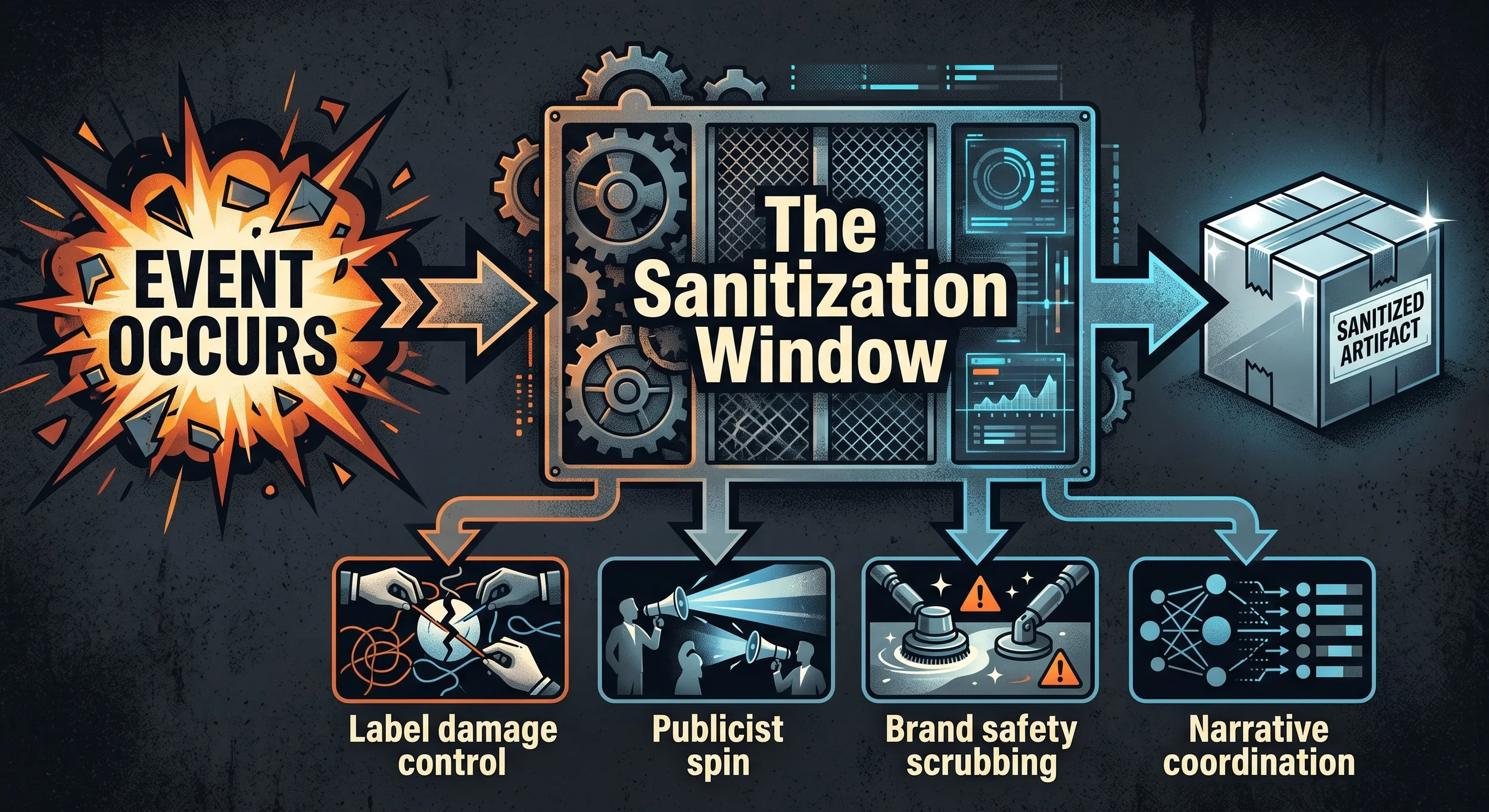
A gritty, modern infographic. On the left, an event spark labeled EVENT OCCURS points into a central filter titled The Sanitization Window. Below it are four sub-processes: Label damage control, Publicist spin, Brand safety scrubbing, and Narrative coordination. An arrow exits the window, pointing to a clean, pristine box on the right labeled SANITIZED ARTIFACT.
The gap between a cultural event occurring and a legacy publication issuing its take is not spent digging for raw truth. It is spent inside an ecosystem of panic:
Record label A&Rs emailing editors to protect contractual priorities.
High-powered public relations firms negotiating which questions are strictly off-limits.
Corporate brand safety teams evaluating whether an honest report could trigger a loss in programmatic ad revenue.
By the time the legacy think-piece is published, it is no longer journalism. It is a focus-grouped press release disguised as cultural analysis. The raw edges have been filed down. The uncomfortable implications have been purged. The public is handed a processed, sterile narrative engineered to ensure that no executive loses a friendship, no brand pulls a budget, and no artist revokes backstage access.
This is why waiting on traditional media has become an act of self-sabotage. The truth exists in the friction of the moment. It exists in the raw, uncoordinated aftermath of an event before the public relations machinery can deploy its smoke screen.
Independent media does not wait because the independent creator does not need a publicist’s blessing to analyze reality. We do not need a label executive's sign-off to tell the audience what they are seeing with their own eyes. The legacy apparatus calls this recklessness. We call it reality.
What We Build From Here
The era of relying on corporate gatekeepers to narrate the condition of hip-hop is over. Their titles are hollow, their loyalties are compromised, and their relevance is sustained only by the inertia of an aging industrial machine.
To break this cycle, independent platforms cannot simply complain about legacy media—we have to outwork, outthink, and outperform it. We have to examine the pioneers who detonated the old distribution model, extract the structural lessons from their victories, and bring a standard of depth and investigative rigor that corporate platforms are fundamentally forbidden from providing.
This is Part I of an ongoing investigative series by The Vanguard, the cultural analysis publication of Storii Online Magazine.
Written By: Storii Online Magazine
Image & Media Credits:
Image 1: Rob Markman
Photographer Credit: Daniel Dorsa
Source: Story in a Bottle
Source Link: https://storyinabottle.charmingrobot.com/2016/07/27/rob-markman/
(Alternative Option)
Photographer Credit: Josue Coretz
Source: The Daily Texan
Source Link: https://thedailytexan.com/2021/03/20/rob-markmans-journey-journalist-to-rapper/
Image 2: Charlamagne Tha God
Photographer Credit: Keith Major
Source: iHeartMedia / Business Wire Press Release
(Alternative Option)
Photographer Credit: Tyler Twins
Source: Simon & Schuster Author Press Kit
Source Link: https://www.simonandschuster.ca/books/Get-Honest-or-Die-Lying/Charlamagne-Tha-God/9781982173807