Suno vs. The Machine: When the Barrier to Entry Drops to Zero
The music industry is currently staring down a real-life Black Mirror episode. For years, the initial veil of AI development has been pushed under the guise of "doing this for humanity's sake," but eventually, we have to ask: how is any of this actually for our sake?
When you hear a genuinely undeniable AI-generated track for the first time—one where you literally cannot tell a machine made it—the visceral reaction is equal parts impressive and terrifying.
Creating an AI this good doesn't happen by accident. It is highly intentional, and to achieve that level of replication, you have to intentionally steal. The real danger isn't just the technology itself; it's the blurring of the line. If a human being plays an instrument and makes a song, that is music. AI-generated audio should be categorized as exactly that—AI-generated. But as those lines blur, the industry faces a terrifying reality: whoever pays the highest bidder gets control of AI. Do we really want some rich executive who knows absolutely nothing about music pulling the levers because we allowed the art form to become fake?
The Pushback and the Panic
In June 2024, the major labels—spearheaded by the Recording Industry Association of America (RIAA)—dropped a massive copyright infringement lawsuit against AI music companies Suno and Udio. The labels alleged "willful copyright infringement at an almost unimaginable scale," demanding statutory damages of up to $150,000 per infringed work.
But the major labels aren't the only ones fighting this war. Entertainment lawyer Krystle Delgado—widely known on YouTube as Top Music Attorney—is leading a massive class-action lawsuit on behalf of independent creators against both platforms. While the major labels have billions to fight in court, independent artists, whose catalogs were swallowed whole by these machines, are fighting not to be sidelined without a remedy. Delgado pointed out that Suno admitted to training its model on "tens of millions" of publicly available sources, the vast majority of which likely belong to independent artists. (Indie artists are currently mobilizing to join the fight through IndieAILawsuit.com).
When platforms like Suno argue that their machine is simply "learning patterns"—just like a human being gets inspired by listening to the radio—the hypocrisy becomes glaring. If a human learned from an artist, copied their exact style, blew up, and made money, they would be sued for stealing. So what is the difference? They think they are generating something that never existed based on things that did exist, but it is still thievery.
Ultimately, watching the major labels and Big Tech fight over AI feels like watching the aliens fight the robots. Or, perhaps more accurately, it's two slave owners fighting over a slave. But amidst the chaos, there's a profound, confusing question: could this technology actually be a chance for freedom? Could artists use AI to get out of predatory label contracts? It is theft, without a doubt, but it is also a disruption of the highest order.
The Fallout: What Happens to the Artists?
If an anonymous kid on the internet can generate a hit without ever stepping into a studio, what is the value of an actual artist going forward?

The answer is simple: AI cannot mimic live performances. It cannot do a tour, it cannot do a stage show, and it cannot do a meet-and-greet. The absolute most an AI can do in the physical world is sell merchandise. Moving forward, true artists are going to win when they expand beyond just making music.
For the artist who only wants to sit behind the boards and make songs, the future is murky. They might have to get comfortable staying behind the scenes, becoming ghostwriters, or perhaps even training their own AI. But for the artists who build a world, who do interviews, and who perform live—the machine cannot replace that human connection.
Tool or Takeover?
The music industry operates in weird little cycles. We have been here before with drum machines, synthesizers, and Napster. Right now, the hype often seems bigger than the actual threat. While AI is nowhere near where it needs to be to completely take over the world, the potential is undeniably there.
It might be a process where we learn to live with it as a tool, and then it eventually takes over. But true artists will never use this route to generate complete, synthetic hit songs and pass them off as human soul. If we can force this technology to remain a tool rather than a replacement, the culture will survive. We have to believe in artists. The industry may be writing its own apocalyptic movie right now, but human beings are still the ones holding the pen.
Written By: Storii Online Magazine
Image & Media Credits:
Legal Research & Sources:
Recording Industry Association of America (RIAA) v. Suno Inc. & Uncharted Labs Inc. (2024 court filings)
Top Music Attorney / Krystle Delgado, Esq. (IndieAILawsuit.com & Top Music Attorney YouTube Channel)
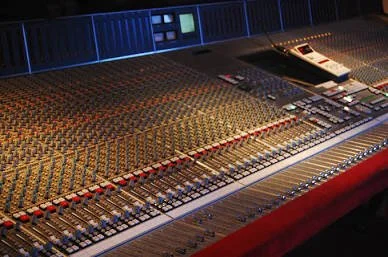
Header Image (Recording Studio Mixing Console):
Credit: Photo via Unsplash / Royalty-Free License
Alt Text: A massive, complex professional recording studio mixing console with hundreds of knobs and sliders
Caption: The traditional studio barrier that AI is actively erasing.
In-Article Image (Live Concert Crowd):
Credit: Photo via Unsplash / Royalty-Free License
Alt Text: A massive crowd of fans at a live music concert with their hands raised in the air toward the brightly lit stage
Caption: The one thing the machine cannot replicate: human connection.