Power to the People: Why DIY Energy is the Next Big Flex
Forget the grid. Here’s how building your own energy independence puts money back in your pocket and freedom in your hands.
Let’s keep it real: most of us are renting our power. We pay the bill, the rates go up, and when the storm hits, the lights go out. We’re at the mercy of the grid. But what if we flipped the script?
For years, energy independence felt like a luxury. That ends now. The technology behind solar power and energy storage has become accessible, affordable, and—most importantly—learnable. This isn’t just about "going green." This is about self-sufficiency. This is about security.
To own your power, you need to understand the science. Here is the technical breakdown of how to build a decentralized energy system.
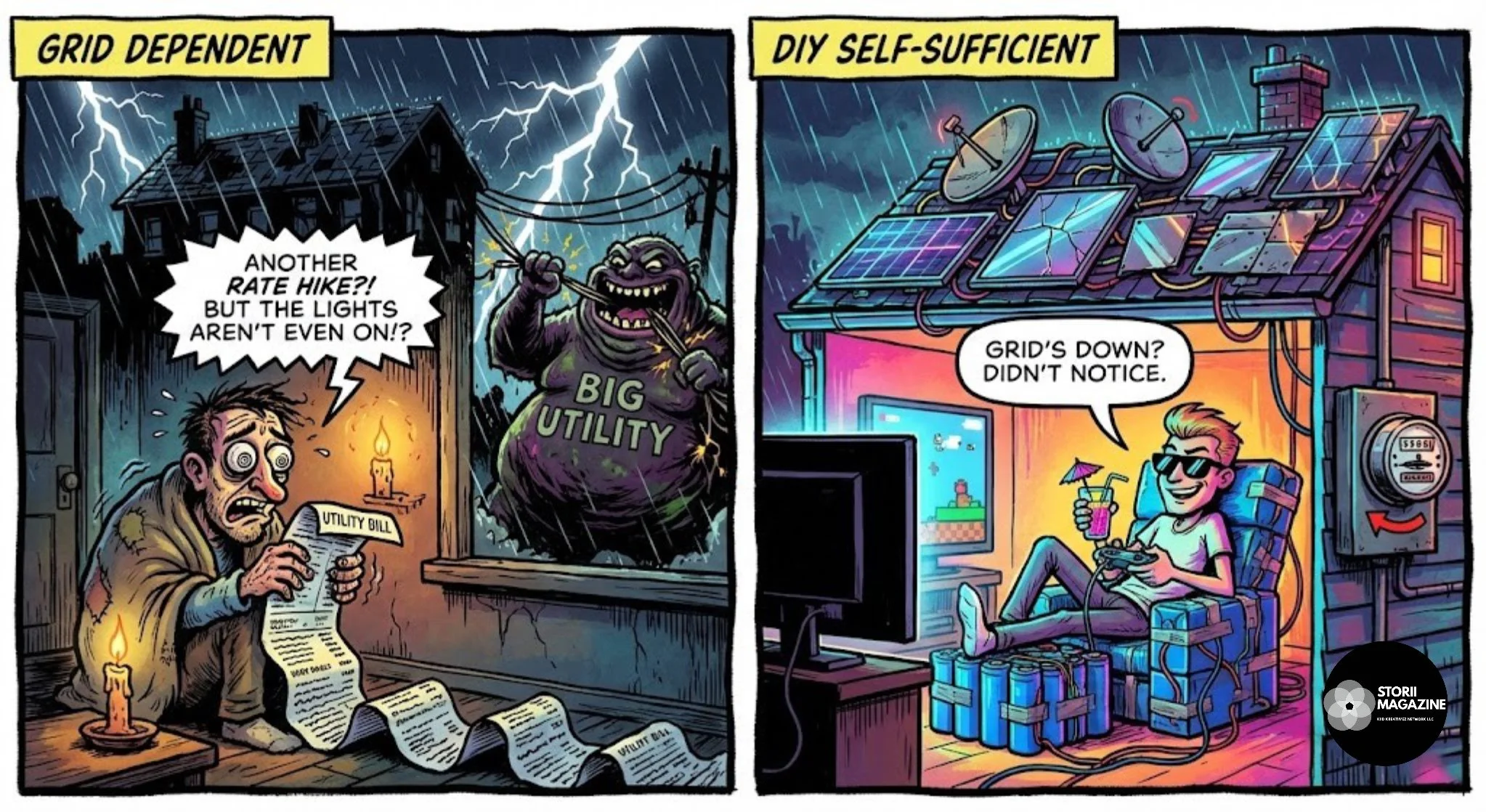
A tale of two houses: While the grid fails the neighbor, the DIY solar setup keeps the vibes alive.
1. The Physics: The Power Law
Before you buy a single wire, you must understand the math. You cannot cheat physics.
Watts (Power): The rate at which energy is used.
Volts (Pressure): The force pushing the electricity.
Amps (Current): The volume of electricity flowing.
The Formula: Watts = Volts x Amps
Why this matters: If you are running a 1000W microwave on a 12V system, you are pulling roughly 83 Amps (1000W / 12V = 83.3A). That requires massive, expensive cabling (0 Gauge) to prevent a fire. If you upgrade to a 24V or 48V system, that amperage drops, allowing for thinner, cheaper, and safer wiring. Rule of Thumb: For systems over 2000W, move up to 24V or 48V to keep amperage manageable.
2. Storage: The Chemistry of LiFePO4
Stop buying Lead-Acid or AGM batteries. They are dead technology. The standard for modern DIY energy is Lithium Iron Phosphate (LiFePO4).
Cycle Life: A Lead-Acid battery dies after ~500 cycles (discharge/recharge). A LiFePO4 battery lasts 3,000 to 5,000+ cycles. That is 10 years of daily use versus 2 years.
Depth of Discharge (DoD): You can only use 50% of a Lead-Acid battery’s capacity before you damage it. You can use 100% of a LiFePO4 battery safely.
The BMS (The Brain): Every lithium battery needs a Battery Management System (BMS). This is a circuit board that sits between the battery cells and the wires. It monitors:
Over-voltage: Stops charging if a cell hits 3.65V.
Under-voltage: Cuts power if a cell drops below 2.5V.
Short Circuit: Acts as a digital fuse.
Cell Balancing: Ensures all cells charge at the exact same rate to prevent degradation.
The Build: You can buy "server rack" batteries, or build your own using raw 3.2V prismatic cells. wiring 4 of these 3.2V cells in Series creates a 12.8V battery (nominal).
3. Harvesting: MPPT vs. PWM
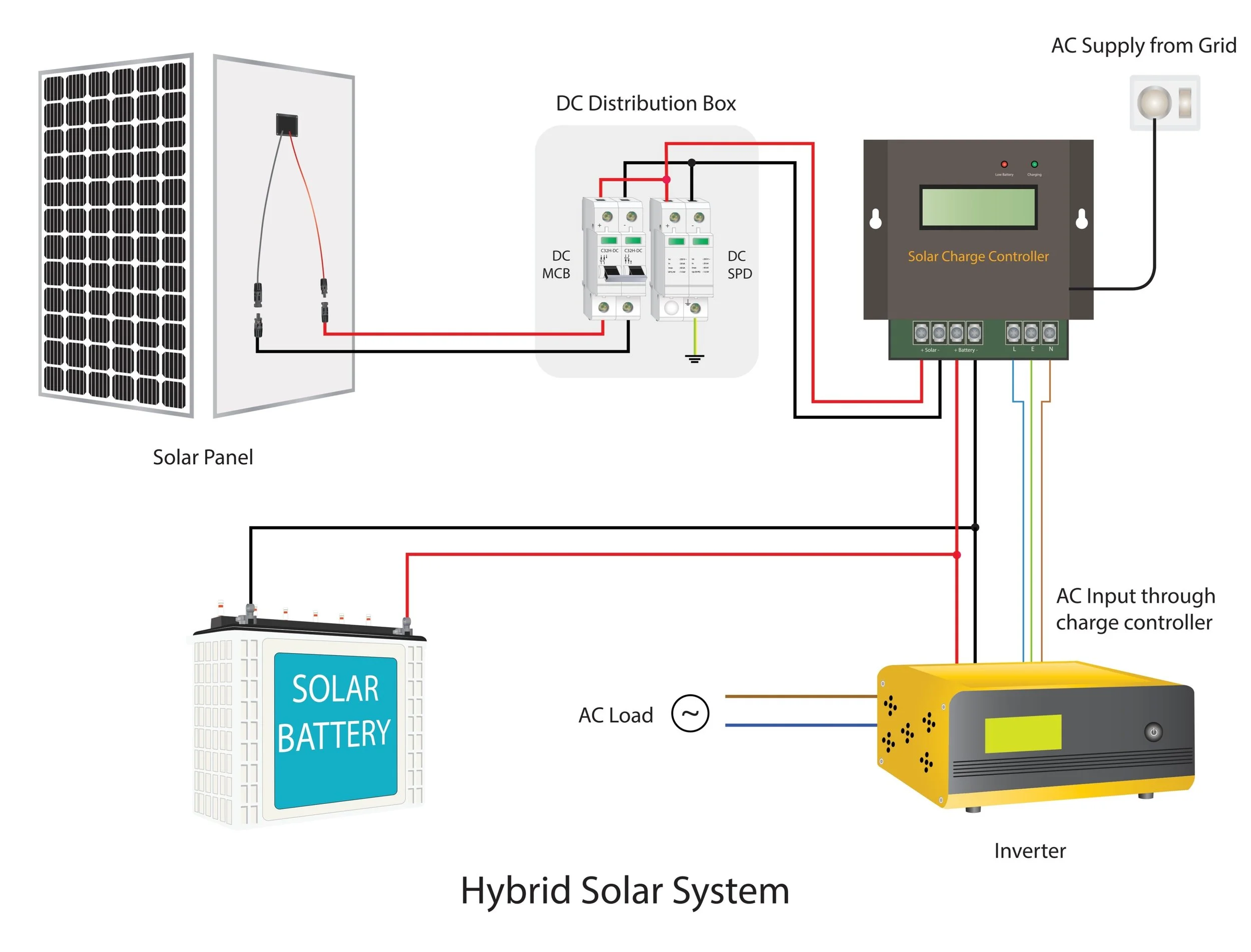
Visualizing the Flow: A complete Hybrid Solar System wiring diagram. This illustrates the journey of your power—from harvesting energy at the Solar Panel, passing through a DC Distribution Box (breakers/safety), regulating voltage at the Charge Controller, storing it in the Battery, and finally converting it to usable AC power via the Inverter. Note the inclusion of the AC Grid supply, allowing this system to switch between solar and grid power automatically.
Credit
Diagram: Shutterstock
The Solar Charge Controller regulates the voltage from your panels to your battery. Never connect panels directly to a battery. There are two types:
PWM (Pulse Width Modulation): Cheap, inefficient. It essentially "clips" the voltage down to match the battery, throwing away the excess energy as heat.
MPPT (Maximum Power Point Tracking): This is what you need. It takes the excess voltage from the panels and converts it into extra amperage.
Example: If your panels are producing 36V at 5 Amps, a PWM controller gives your battery ~13V at 5 Amps (65 Watts). An MPPT controller converts that to ~13V at 13 Amps (169 Watts).
Efficiency Gain: MPPT is up to 30% more efficient than PWM. Do not waste your money on PWM.
4. Delivery: The Pure Sine Wave Inverter
The Inverter takes the DC (Direct Current) power from your battery and turns it into AC (Alternating Current) for your wall outlets.
Crucial Spec: You must buy a Pure Sine Wave inverter.
Modified Sine Wave: Creates a "blocky" electrical wave. This causes motors (fridges, fans) to run hot and buzz, and can destroy sensitive electronics like medical CPAP machines or audio equipment.
Pure Sine Wave: Creates a smooth wave identical to (or cleaner than) the grid. Safe for everything.
Sizing the Inverter: Total up the wattage of everything you want to run at once. If you need 1500W total, buy a 2000W inverter to give yourself "headroom." Running an inverter at 100% capacity creates heat and shortens its lifespan.
5. Safety: The Fuse is Your Friend
A DIY battery is a bomb if you treat it wrong. You need Overcurrent Protection (OCP).
Fuses/Breakers: Must be placed on the positive wire as close to the battery terminal as possible.
Sizing: If your system is designed for 100 Amps, use a 125 Amp fuse. This ensures the fuse blows before the wire melts, but doesn't blow during normal surges.
Disconnect Switch: Always install a physical switch to cut power from the panels and the battery instantly in an emergency.
Cutting out the middleman: Why renting your power is a thing of the past.
Summary: Your Shopping List for Freedom
Battery: LiFePO4 (12V 100Ah is the standard starter size).
Controller: Victron or EPEVER MPPT Charge Controller.
Panels: Monocrystalline Solar Panels (High efficiency).
Inverter: 1000W-2000W Pure Sine Wave Inverter.
Wiring: Pure Copper wires (Avoid CCA - Copper Clad Aluminum, it overheats).
In a world that wants us dependent, the most revolutionary thing you can be is self-sufficient. The math doesn't lie, and the sun doesn't send a bill. Let’s get to building.
Written By: Storii Online Magazine
Technical Diagrams & Stock Photos: Shutterstock
Original Illustrations: Kiid Kreatiivez Network LLC / Generated via AI
Source Material: Official documentation for Victron Energy & LiFePO4 Battery Chemistry Standards.